Seminario 4th STS Lab Meeting
17 dicembre 2025
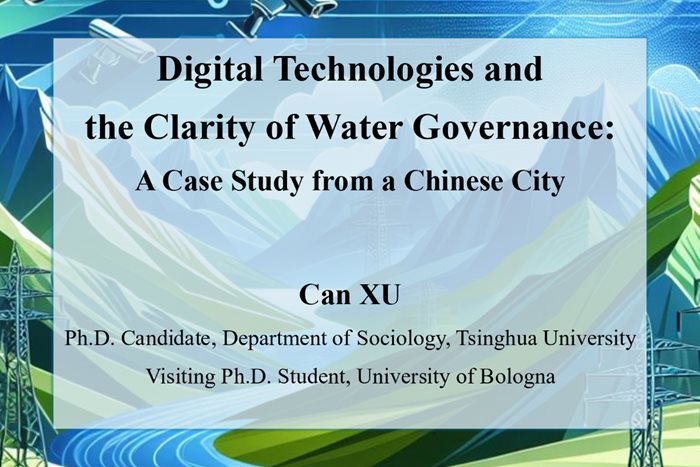
Can Xu - Digital Technologies and the Clarity of Water Governance: A Case Study from a Chinese City
- 09:00 - 11:00
- In presenza : Via Zamboni 38, Sala Apollo, Bologna
- Scienza e tecnologia In inglese
Per partecipare
Ingresso libero
Programma
This lecture draws on a three-year ethnographic study (October 2021–October 2024) of digital technologies and “clarity in water-environment governance” in China. Focusing on contemporary water-environment governance as its empirical site, it adopts an ethnographic design that combines laboratory-based research with an embedded internship in government departments. Through participant observation and unstructured interviews, the study examines how digital technologies reshape the state’s capacity to “see” and to “govern” in the domain of water environments. Beginning with the construction of data indicators and traceability schemes, it analyzes how governance outcomes and governance objects are rendered increasingly clear through digitalization, how this pursuit of clarity normalizes a highly interconnected mode of water-environment governance, and how it redistributes control within relations of technology and power.
Building on this, the lecture further explores the problem of “excessive clarity” generated by digital technologies: governance processes become fully datafied and continuously monitored, yet in practice this can fuel “digital formalism” for frontline actors—a build-up of “digital negative energy,” that is, an affective and organizational drag produced by digital systems. These dynamics generate tensions between the ideals of digital transformation and the lived experience of governance on the ground.
Finally, the talk proposes an analytical framework of “moderate clarity” to show how, in the digital era, state informational capacity becomes stratified: informational advantages may be reversed between central and local levels and across departments, and digital technologies amplify differences in how various tiers of government collect, process, and use information. By opening the twin black boxes of digital technology and water-environment governance, the lecture offers a frontline empirical vantage point from which to reflect on the boundaries, risks, and possibilities of digital governance.
Chi interverrà
-
Can Xu
Visiting Researcher